
An Irrevocable Life Insurance Trust (ILIT) Acts as a Bridge Over Troubled Waters
Inspired by Bridge Over Troubled Water, written by Paul Simon and made famous by Simon & Garfunkel, with Art Garfunkel's unforgettable lead vocal. This article follows the song's themes and imagery without reproducing its lyrics.

The song Bridge Over Troubled Water begins in a place of weariness, uncertainty and isolation. It recognizes that there are moments when a person simply cannot carry every burden alone. Its answer is the promise of a steady presence - a bridge strong enough to carry someone safely over the turbulence below.
That is also a fitting way to understand an Irrevocable Life Insurance Trust,commonly called an ILIT.
An ILIT is often described primarily as an estate-tax planning strategy. That description is accurate, but incomplete. A properly designed ILIT can also provide liquidity, preserve privacy,support an orderly business or family succession plan and protect beneficiariesfrom having to make difficult financial decisions while they are grieving.

When the Waters Become Troubled
The opening part of Simon's song acknowledges exhaustion, tears and the feeling of facing hardship alone. In estate planning, those troubled waters often arrive when death, grief and probate begin at the same time.
A surviving spouse and children may suddenly face two very different kinds of pressure. Emotionally, they are coping with the loss of someone central to the family. Financially and administratively, they may be asked tomake immediate decisions about:
• Funeral expenses, final bills,debts and possible estate or inheritance taxes
• Business ownership, management and succession
• Realestate and other valuable assetsthat may be difficult to divide
• Support for a survivingspouse and the differing needs of children
• Managing inheritances for young or financially inexperienced beneficiaries
• Whether important family assets must be borrowed against or sold
These questions would be difficult under ideal circumstances. During grief, they can become overwhelming.
Without advance planning, a familymay have to decide which assets to sell, who will control the business, how to dividean illiquid estate or where to obtain cash.Family members may disagree - not because anyone is acting in badfaith, but because they are tired, frightened and interpreting the deceasedperson's wishes differently.
The family is being asked to design a bridge while already standing in the storm. An ILIT allows many ofthose decisions to be made beforehand, when the family has time to consider its goals thoughtfully.
The Promise of a Bridge
As the song develops, it answers distress with reassurance. It does not promise that the troubled water will disappear. Instead, it promises that there will be a dependable way across it.
An ILIT works in much the same way.It cannot remove grief, prevent every family disagreement or guarantee that financial markets and tax laws will never change. What it can do is establish a structure before the crisis begins.It can provide money, instructions, management and continuity precisely when the family maybe least prepared to create those things for itself.
The bridge does not eliminate the storm. It keeps the family from having to enter the water.
How the Bridge Is Built
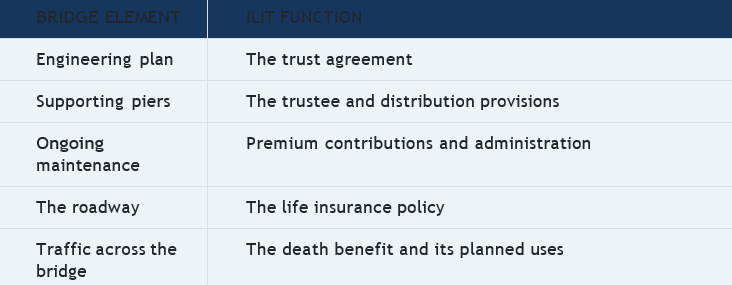
Every durable bridge begins with a design. For an ILIT, that design is the trust agreement prepared by a qualified estate-planning attorney.
The trust agreement identifies:
• Who may benefit from the trust and who will serve as trustee
• How and when money may be distributed
• Whether and how a surviving spousemay receive benefits
• How children and later generations will be treated
• Whether funds may be used for health, education, maintenance or support
• How business interests and other family assets should be protected
• What happens if circumstances change
Once the trust is established, it generally appliesfor and becomes the owner and beneficiary of a life insurance policy. The insured should not retain rights the tax law considers "incidents of ownership," such as the power to change beneficiaries, surrender the policy,assign it or borrow against it. Retaining those powers can cause the proceeds to be included in the insured's taxable estate.
Whenever possible, the ILIT should purchase a new policy from the beginning. That is like designing and building a new bridge on the trust's own right-of-way. From the first day, the bridgeis governed by the ILIT's ownership structure, trustee oversight and estate-planning safeguards.
Transferring an existing policy is more like acquiring an older bridgethat was originally built on someone else's right-of-way. Legal ownership must be transferred, the former owner must surrender control and the bridge must begin operating under the trust's updated safety rules.
Even after those changes are made, the tax law preserves a three-year connection to the former owner. If the insured dies during that period, the policy proceeds may be brought back into the insured's grossestate. After the three-year period has been crossed, that old right-of-way generally no longer connects the policy to the insured's estate.
The family then contributes funds to the trust so the trustee can pay the premiums. Depending on the trust's design, beneficiaries may receive temporary withdrawal rights and written notices - often called Crummey notices - socontributions may qualify for the federal annual gift-tax exclusion. These procedures must be followed consistently; an ILIT cannot simply be signed and placed in a drawer.
The Road Across the Bridge
Life insurance death benefits are generally received free from federal income tax, although exceptions can apply.When an ILIT is properly created, funded and administered - and the insured does not retain prohibited ownership rights- the proceeds may also remain outside the insured's estate for federal estate-tax purposes.
That combination can create a substantial pool of privateliquidity at precisely the moment a family may need it most. The trustee maybe authorized to:
• Provide for the surviving spouse and descendants
• Lend money to the estate on appropriate terms or purchase assets from it
• Supply liquidity for estatetaxes, debts and expenses
• Prevent a forced sale of a business, farm, real estate or investment portfolio
• Equalize inheritances when one child receives the family business and another does not
• Hold funds for younger beneficiaries and distribute assets gradually
• Continue protection from creditors, lawsuits or poor financial decisions, to the extent permitted by law
The ILIT should not necessarily berequired to pay the estate's obligations directly. That could undermine important tax or asset-protection objectives. Instead,the trustee follows the authority and procedures established in the trust agreement.
The objective is not merely to create money.It is to create money accompanied by instructions.
The Trustee as Caretaker of the Bridge
A bridge requires a caretaker who understands its design and keeps it functioning. In an ILIT,that person or institution is the trustee.
The trustee may be responsible for:
• Applying for and owning the insurance and reviewing policy performance
• Receiving contributions, sending requirednotices and paying premiums
• Maintaining trust records and filing any necessary tax returns
• Communicating with beneficiaries and collecting the death benefit
• Investing and distributing the proceeds
• Exercising independent judgment during family disagreements
The trustee's role becomes especially important after the insured's death. The trustee is not supposed to react impulsively to whichever family member speaks most forcefully. The trustee must follow the trust agreement, applicable law and the fiduciary duties owed to the beneficiaries.
A capable trustee inspects the bridge, keeps the roadway clearand helps prevent temporary emotion from becoming permanent financial damage.
Succession Without a Forced Sale
The final movement of Simon's song shifts from immediate comfort toward hope, forwardmotion and a future that can still unfold. An ILIT can serve the samepurpose in a succession plan.
Consider a parent whose estate consists largely of a closely held business. One child works in the company andis prepared to lead it. Two other children have chosen different careers.
Without liquidity, the family may face unpleasant choices. The business might have to make distributions it cannot afford. The child taking control may have to borrow heavily. The otherchildren may receive illiquid minorityinterests they do not want.In the worst case, the businessmay have to be sold simply to divide the estate.
An ILIT can provide separate value for the childrenwho are not receiving the business. This can allow the operating child to continue the company while giving the other children a meaningful inheritance. The same principle can apply to farms, apartment buildings, vacation propertyand other assets that cannot be divided neatly.
The life insurance does not makeevery beneficiary receive identical property. It can help the overall plan treat them fairly. The family can continue its journey without dismantling everything the insured spent a lifetime building.
Privacy Beyond Probate
A will generally becomespart of the public probate record. A properly administered ILIT usually operates outside the insured'sprobate estate, allowing its assets and distribution instructions to remain more private than they would under a will alone.
That privacy is not absolute. Litigation, statelaw, beneficiary rightsand other circumstances can require disclosure. Nevertheless, an ILIT may keep sensitive family and financial decisions out of routine probate filings.
Privacy can matter when the estate includes a family business, unequal inheritances, beneficiaries with special needs or family circumstances that should not become publicsimply because someone died.
In bridge terms, not every traveler needs to know who crossed,what each personcarried or where every passenger was going.
Spousal Access: The Bridge's Safety Shoulder
Because the trust is irrevocable, the insured generally cannot treat its assets as personal funds.That loss of direct ownership and control is essential to many of the ILIT's estate-tax advantages.
However, a well-designed bridge needs more than ordinary traffic lanes. Its safety shoulder must be wide enough and strong enough for emergency vehicles to get through when the main road is blocked.
In much the same way, an ILIT can often be designed to include the insured's spouse as a beneficiary, creating a carefully controlled route for assistance when the family encounters an unexpected need.
The safety shoulder is not reserved only for catastrophic emergencies. It can be designed broadly enough to help the spouse continue living in the manner to which the spouse and family were accustomed. Federal regulations recognize that "support" and"maintenance" are not limited to life's bare necessities and mayinclude support in one's accustomed manner of living.
Depending on the trust's language, the trustee may provide for:
• Housing and household expenses
• Medical, dental and long-term care needs
• Education expenses
• Travel and transportation
• Family support and unexpected financial emergencies
• Reasonable comforts consistent with the spouse's established lifestyle
• Other needs authorized by the trust
The spouse does not necessarily have an unrestricted personal right to withdraw the money. Instead, the trustee makes- or authorizes - distributions under the standards established in the trust agreement.
The emergency lane is notan unrestricted travel lane. The insured cannot demand the money, direct the trustee to return it or continue exercising personal controlover the policy.The trustee serves as the gatekeeper, determining when authorized assistance may enter the roadway and ensuring that everydistribution follows the trust's terms.
Spousal-access provisionscan therefore provide a broad and valuable safety shoulder. They give the plan room to respond when the bridge becomes blocked without surrendering theownership structure and protective guardrails that made the bridge secure inthe first place.
The trust might also give the spouse a limited power to direct where remaining assets pass at death. However, everyspousal-access provision must be drafted carefully. Divorce or the spouse's earlier death can eliminate thatroute of access. Overly broad personal powers may create estate-tax problems for the spouse.Couples creating separate trusts for one another must also be careful not to establishsubstantially identical arrangements that could be challenged under the reciprocal-trust doctrine.
Spousal access can be broad and useful, but it is a source of carefully designed flexibility - not a promise that the insured continues toown or control the trust's assets.
Building Before the Storm
The most important lesson in the bridge metaphoris timing. A bridge is valuable during a flood because it was built before thewater rose.
Likewise, an ILIT worksbest when the family establishes it before illness,conflict, incapacity or death forces everyone to act quickly.The family can decide in advance:
• Who should be protectedand who should manage the money
• How much liquidity may be needed
• Which assets should remain in the family
• Howa surviving spouse will be supported
• How children should participate in the business
• How inheritances should be protected and distributed
Those decisions are more likely to reflect the family's values when they are made calmly, deliberately and together.
More Than a Tax Strategy
An ILIT can help protect life insurance proceedsfrom federal estate taxation when it is properlystructured and administered. It may also reduce probate exposure, improveprivacy, create succession liquidity and provide disciplined financial support for a spouseand later generations.
But its deepest purpose is more human.
It replaces hurried decisions with earlier instructions. It replaces forced sales with liquidity. It replaces uncertainty about succession with a written plan.It gives a trustee the responsibility to preserve the crossing when grief makes the waters rough.
Simon & Garfunkel's recording endures because it expresses a promise of support during life's hardest moments.An ILIT can embody a similar promise:when the family is weary, frightened or divided by difficult choices, a bridge will already be there.

Sources
Internal Revenue Code Section 2042,life insurance proceeds and incidents of ownership: law.cornell.edu/uscode/text/26/2042
Internal Revenue Code Section 2035, certain transfers made within three years of death: law.cornell.edu/uscode/text/26/2035
IRS guidance on life insurance and disability insurance proceeds: irs.gov - Life Insurance& Disability InsuranceProceeds
Treasury Regulation Section 20.2041-1(c)(2), support and maintenance in an accustomed manner of living: ecfr.gov - 26 CFR 20.2041-1
This article is for general educational purposes only and is not legal, tax or investment advice. ILITs are irrevocable legal arrangements whose effectiveness depends on their drafting, ownership structure, funding and continuing administration. Families should coordinate the work of a qualified estate-planning attorney, tax advisor, trustee and experienced life insurance professional.